Image

DRYCORE™

Cool Drying Science

Cool drying is the future.

We are proud to announce the DRYCORE™ range of innovative cool drying systems, adapted and customised to provide a turnkey agricultural drying solution for any climate, weather or product.
Image
The advantages of Cool Drying
The drying process is a cool air-controlled process which preserves the product by inhibiting the growth of micro-organisms, be it moulds & spores or bacterial growth. The drying/curing temperature can be adjusted between 15°C and 30°C, or be fixed if product specific, to ensure an optimal cooling rate and minimum energy consumption.

100% Controlled drying process

Improve product quality

Reduces time of drying process

Decreased risk of mould & other contamination

Protects the product against all external environmental elements

Financial gain on product price

Image

SIMPLE

The DRYCORE™ range provides a turnkey solution to cool dry any and all produce within customised shipping containers. Each unit is custom-built and suited to your needs, providing benefits such as a higher quality product, production streamlining and effective use of space.

Image

smart

The DRYCORE™ units have built-in smart technology allowing for remote access and monitoring of the drying system, as well as tamper-proof technology and alarms. Real time monitoring and control are becoming industry standard and provide true real time control.

Image

efficient

The DRYCORE™ range provides cool drying in any climate or weather due to the controlled enclosed cooling spaces, cutting down on cooling time and providing a higher quality product, all at the same time.

DRYCORE™

principle of drying

The system operates as a control volume in which the tem­pe­ra­ture and the humidity are accurately controlled. The extraction of moisture depends on the characteristics of the specific product. These characteristics determine the drying time and the product’s minimum moisture percentage.
Image

DRYCORE™

Typical Cool Drying Models

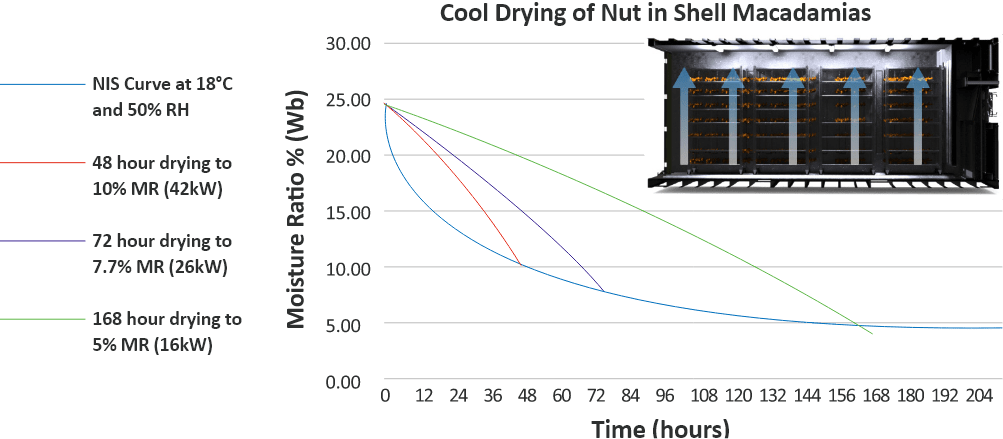
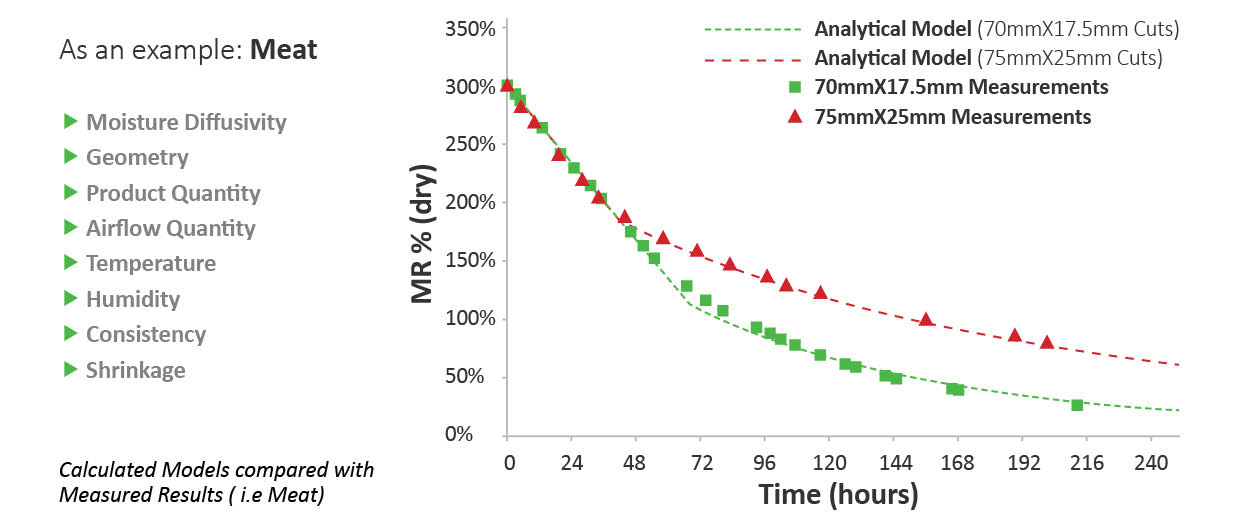
Each product has its own drying characteristics and moisture diffusivity. Product geometry and quantity play an important role and it is essential to first calculate a drying model before deciding how much drying capacity is required. Specific energy consumption (SEC) is measured in kWh/kg of moisture removed and is an important parameter to consider especially in terms of operational cost of the drying process. The graphs also show the accuracy of the models compared to the measurements which Drycore has developed to calculate the required system capacity and characteristics.
Image